Body Parts Matching Activity
Learning body-part names can help children build vocabulary, understand categorization follow everyday directions, and communicate more clearly about their bodies.
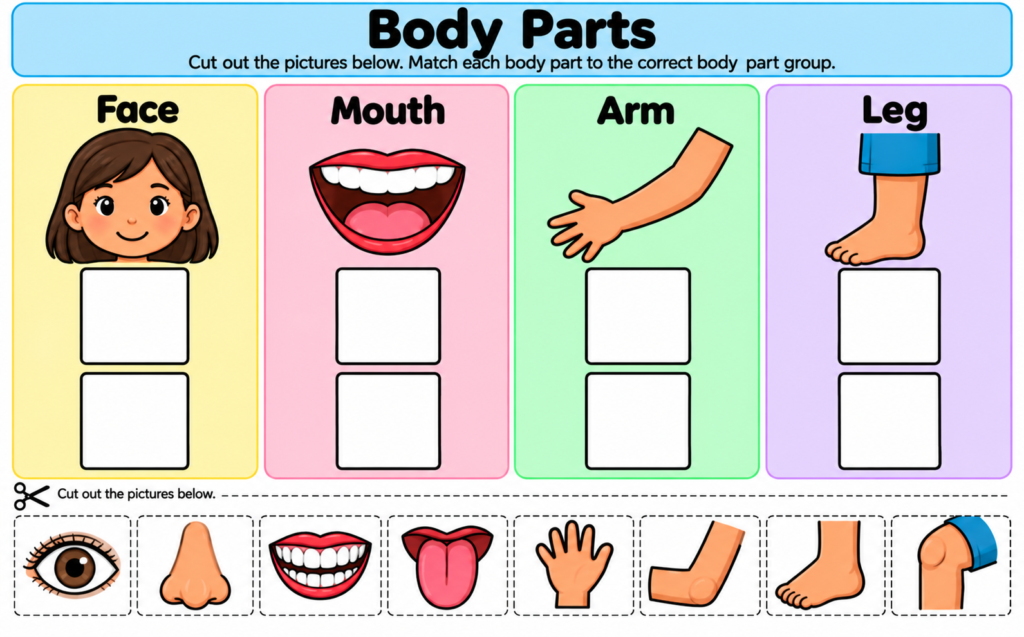
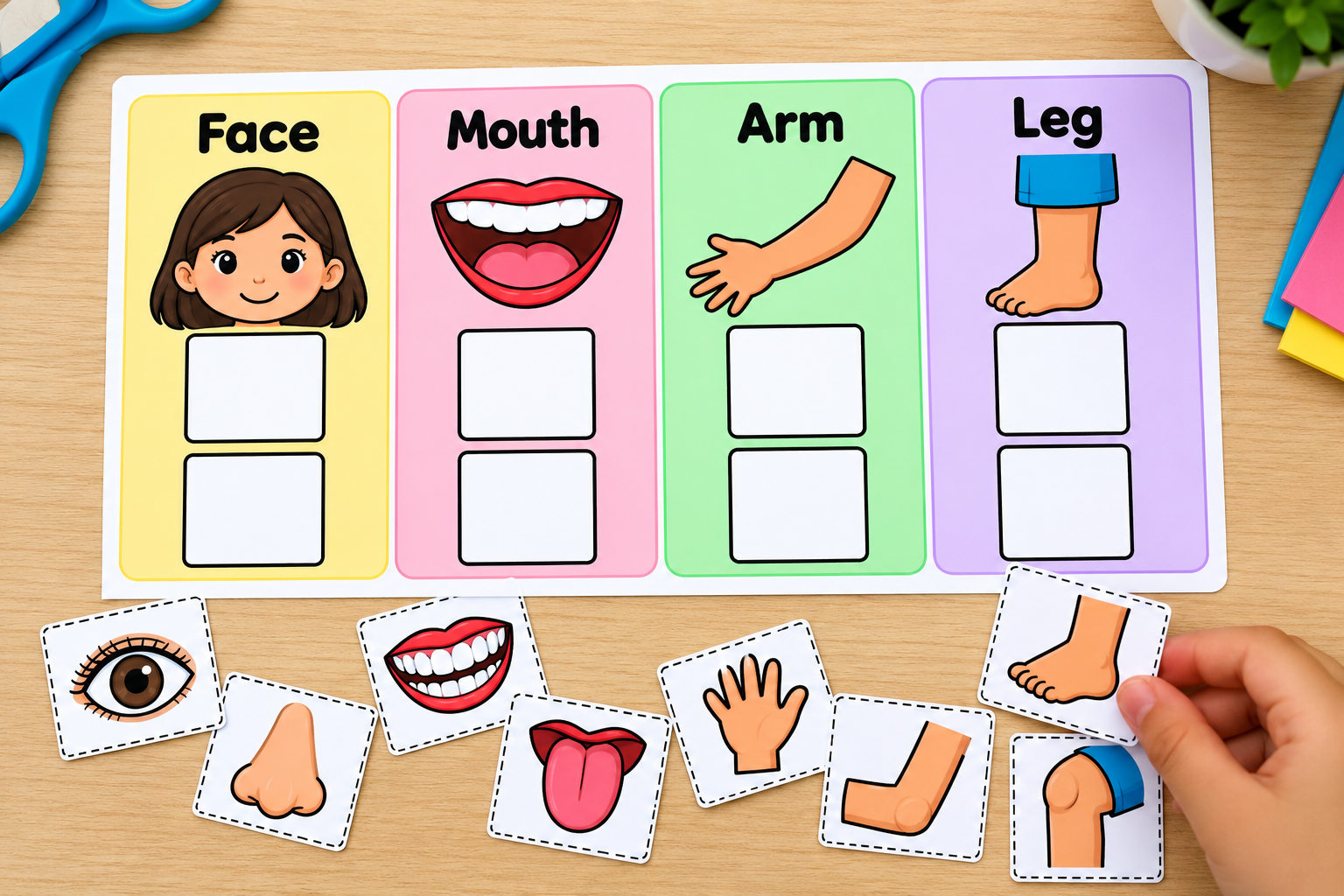
This Body Parts Matching Activity is designed to be laminated and reused with Velcro, making it a simple hands-on activity for home, school, therapy, or learning centers.
How to Set It Up
Print the activity, cut out the body-part picture cards, and laminate the page and individual cards.
Add Velcro dots to the blank spaces and the backs of the picture cards.
Children can then match:
Face: eye and nose
Mouth: teeth and tongue
Arm: hand and elbow
Leg: foot and knee
Once it is laminated, the activity can be used again and again without needing to reprint it.
How to Use It
Give the student one or more picture cards and have them attach each card to the correct category.
You can add simple language while they work:
“Where does the hand go?”
“Find the nose.”
“Show me your knee.”
For children who need more support, present only two choices at a time or model the first match.
Extend the Learning
After matching the pictures, connect the activity to the child’s own body.
Try:
“Touch your nose.”
“Show me your elbow.”
“Where is your foot?”
This helps connect the picture, the word, and the actual body part.
Why Use a Visual Matching Activity?
Repeated practice with matching activities can also help strengthen learning. Research on matching-to-sample instruction shows that structured, hands-on practice can improve visual discrimination and matching skills. In one study, children with autism improved their matching accuracy after a step-by-step tabletop sorting-to-matching procedure. Read the matching-to-sample research on PubMed.
A Simple Reusable Learning Tool
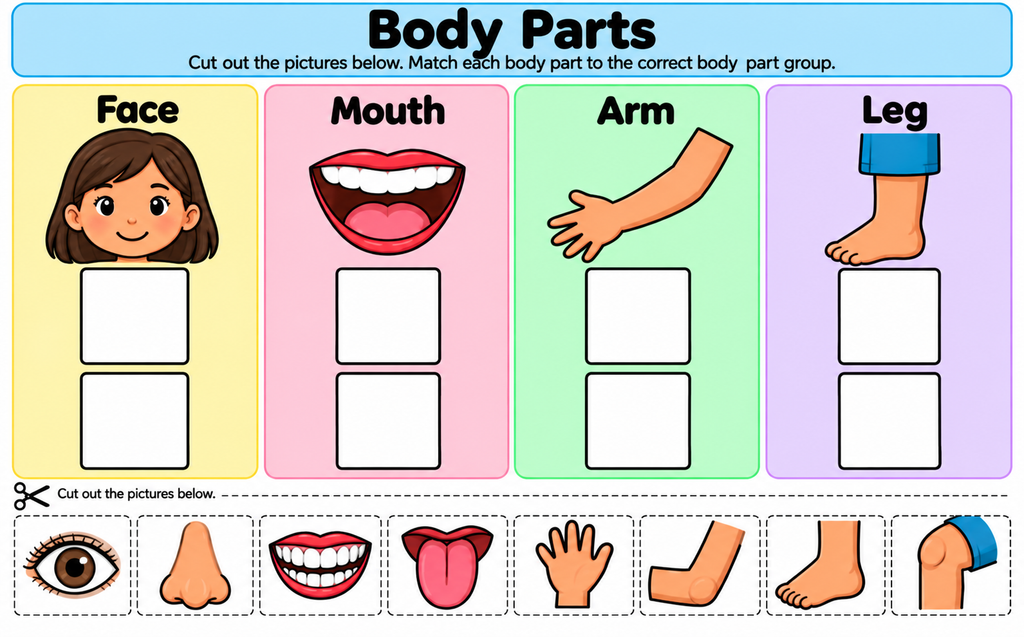
Laminating the activity and adding Velcro turns one printable into a reusable learning material that can be practiced in short manageable steps and revisited as the child builds independence.

Rachel Wise is the author and founder of Education and Behavior. Rachel created Education and Behavior in 2014 for adults to have an easy way to access research-based information to support children in the areas of learning, behavior, and social-emotional development. As a survivor of abuse, neglect, and bullying, Rachel slipped through the cracks of her school and community. Education and Behavior hopes to play a role in preventing that from happening to other children. Rachel is also the author of Building Confidence and Improving Behavior in Children: A Guide for Parents and Teachers.
"Children do best when there is consistency within and across settings (i.e., home, school, community). Education and Behavior allows us to maintain that consistency."
- Rachel Wise
- Rachel Wise
- Rachel Wise
- Rachel Wise
- Rachel Wise
- Rachel Wise
- Rachel Wise
- Rachel Wise
- Rachel Wise
- Rachel Wise
- Rachel Wise
- Rachel Wise
- Rachel Wise
- Rachel Wise
- Rachel Wise
- Rachel Wise
- Rachel Wise
- Rachel Wise
- Rachel Wise
- Rachel Wise
- Rachel Wise
- Rachel Wise
- Rachel Wise
- Rachel Wise
- Rachel Wise
- Rachel Wise
- Rachel Wise
You May Also Like
Releated Topics
Can a Question Before Learning Help Kids Remember More?
What Do I Use? Everyday Object Hands-On Matching Activity
Big Feelings Social Story: Helping Kids Manage Strong Emotions